130 conflicts worldwide, crises on the rise… what can diplomacy do?

Automatically generated translation
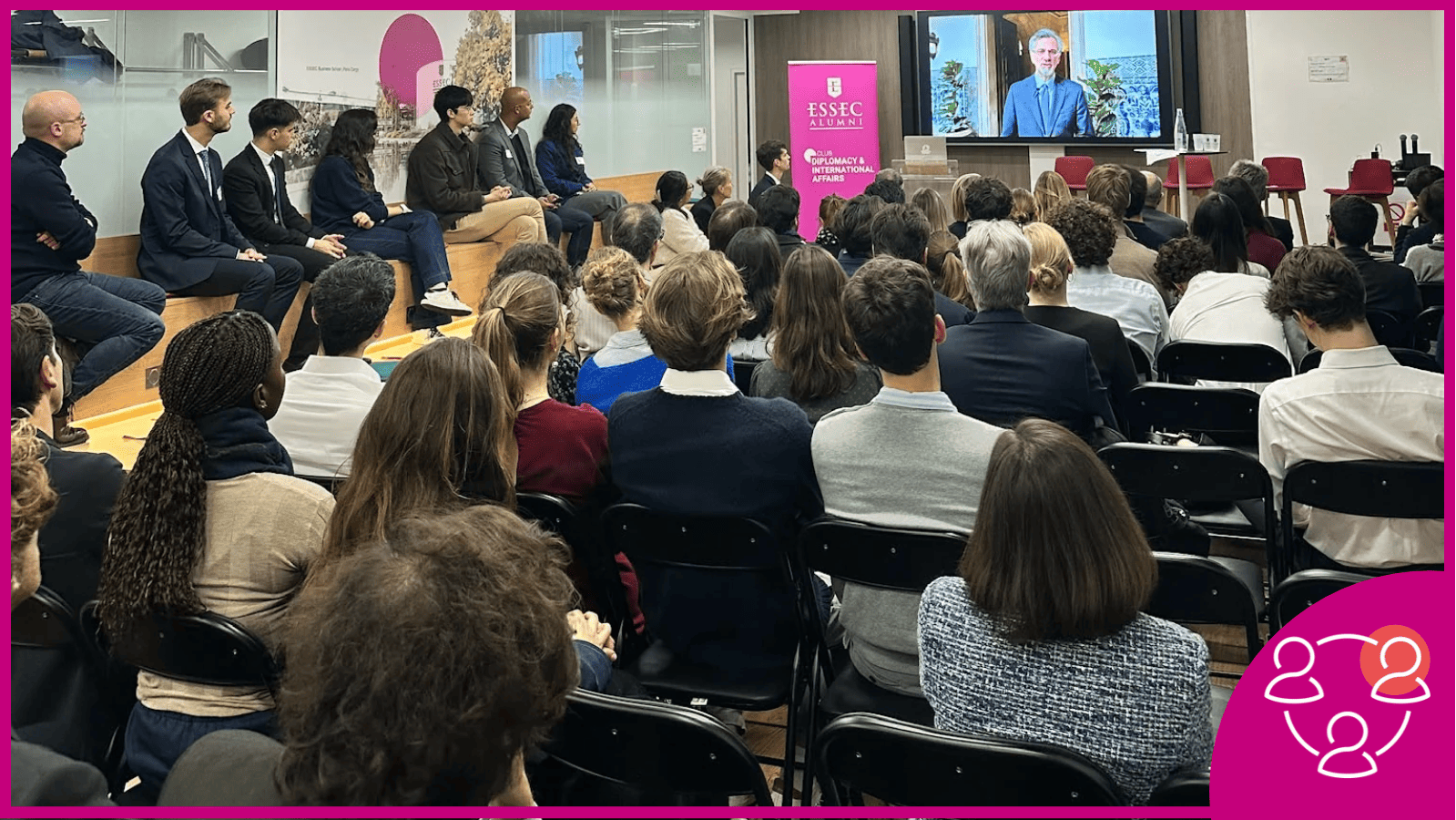
On 16 November, the Maison des ESSEC hosted the launch evening of the ESSEC Alumni Diplomacy & International Affairs Club, a newly created club chaired by Jean-Baptiste Varnat (E24). At the heart of the discussions was one question: at a time when crises are multiplying and overlapping, what can diplomacy achieve in 2027?
Opening the evening by video message, the club’s honorary president, Jean-Pierre Asvazadourian, French Ambassador to Portugal, set out its purpose: ‘A significant number of the school’s alumni have become diplomats. (…) The club can serve to bring people together and to foster the sharing of experience in an intergenerational spirit.’ He went on: ‘The knowledge acquired at ESSEC is invaluable, as economic diplomacy takes on an ever greater role in diplomatic action.’
ESSEC alumni who have become diplomats have fully grasped the scale of a world in upheaval. ‘You may not be interested in war, but war is interested in you’: in his opening remarks, Gaël Veyssière (E94), Director of the Crisis and Support Centre at the French Ministry for Europe and Foreign Affairs and former French Ambassador to Ukraine, quoted these words of Lenin. He explains: ‘I grew up at the Quai d’Orsay as a diplomat of the good times. Then, at one point in my career, crisis caught up with me: I was appointed French Ambassador to Ukraine in 2023, a year and a half after the war began.’
There are currently said to be 130 conflicts around the world, according to the International Red Cross. ‘There are more open crises than we have ever seen since the Second World War; they last much longer, and they pile up. Threats are also of a new kind today: hybrid, reputational, and tomorrow perhaps artificial intelligence,’ Gaël Veyssière continues.
The principles that shaped the post-Second World War order now seem distant. ‘What is new since 2022 is that Russia, a permanent member of the Security Council, is acting in total violation of the principles of the United Nations Charter,’ Gaël Veyssière continues.
The traditional ways of resolving crises are seizing up. ‘What had been the main factor of stability in the international system since 1945 has itself become a source of crisis. I am thinking, of course, of the United States. The American president can strike Iran, then threaten Denmark and Greenland the next day. The atmosphere is anxiety-inducing, and crises can erupt where we least expect them. Who could have imagined, for example, a crisis in Greenland?’ asks Gaël Veyssière.
What role for the European Union?
In this context, the European Union has a real card to play, says Gilles Bertrand (E 93), European Union Ambassador to Venezuela. ‘What is striking is that at a time when there is enormous doubt about the Union internally, quite a large number of partners are turning to us. Europe comes across as a predictable actor, one that defends multilateralism and which, precisely because of the corset of rules agreed between twenty-seven sovereign states, remains predictable and trustworthy.’
Yet those same rules sometimes force a long-term view, while technology is accelerating. ‘Tech moves very fast, and it sometimes clashes with the pace of diplomacy, which takes longer,’ acknowledges Caroline Vandierendonck (E06), Head of Unit at the European Commission’s Directorate-General for Budget. She refuses, however, to see this as inevitable: ‘A crisis is a rupture, but it is also an opportunity: for us in Europe, the opportunity to hold our course. We are among the best in clean tech, and we were pioneers in nuclear power. The risk is losing our course and becoming a weathervane.’ She adds: ‘The line between peace and conflict is becoming less and less visible. What we control is where we want to go as a continent.’
Indeed, the European Union has already shown that it can act quickly. ‘During the Covid crisis, for the first time, we borrowed on the markets on behalf of the Union to finance the major NextGenerationEU investment plan, €800 billion. That was not provided for in the treaties. Yet we were able to respond,’ Caroline Vandierendonck recalls.
European rules and standards can bring other global giants on board. ‘When you set standards before others and account for 20% of the world market, it is easier to be followed,’ Gilles Bertrand stresses, citing the European law on artificial intelligence. Provided, however, that Europe acts collectively. He concludes: ‘The European Union exists when it speaks with one voice.’

Comments0
Please log in to see or add a comment
Suggested Articles


