
Decision-Making in a Polycrisis: When Complexity Becomes Strategic


Automatically generated translation
AI, geopolitical tensions, economic transformations… Crises no longer follow one another: they overlap, accelerate and feed on each other. In a world of polycrisis, how do you make decisions? That was the theme of the Lifelong Learning by ESSEC Alumni evening, held in partnership with ESSEC Executive Education on 13 October at the Maison des ESSEC.
There was no question of saying “things were better before”. For Vincenzo Vinzi, Dean & President, ESSEC Business School, the world is certainly uncertain, complex and volatile, but that is nothing new. “What has changed is the simultaneity of crises and the speed at which they evolve.” In this context, thinking in silos is impossible. Vincenzo Vinzi argues for breaking down the barriers between topics. “Just because a new topic comes along doesn’t mean we have solved the previous one.” Another imperative: continuing to learn throughout life. While the School’s mission is to “teach people how to learn”, education in no way stops when professional careers begin.
Recognising your skills
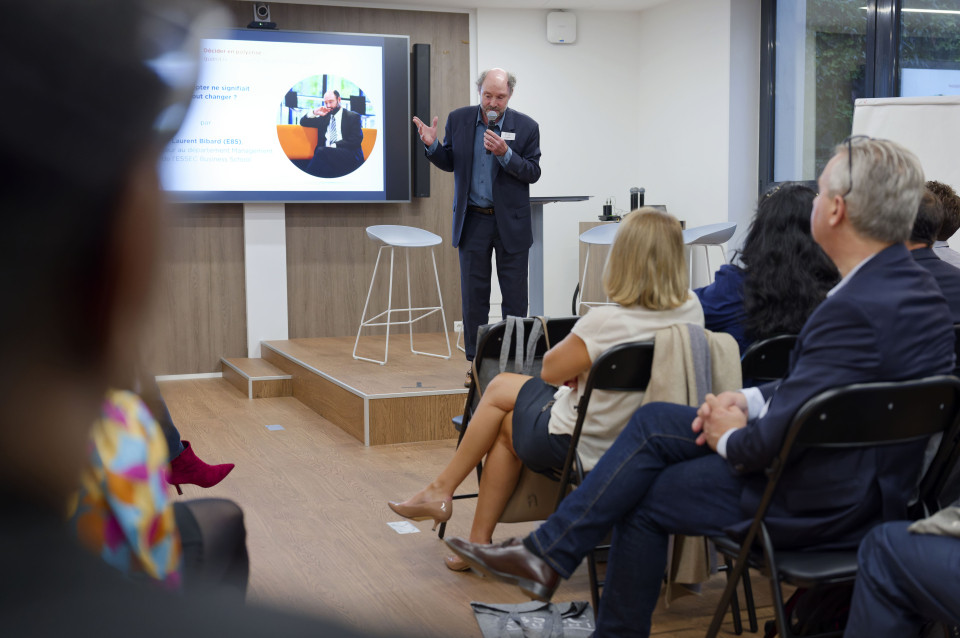
Faced with polycrises, the attitude individuals adopt therefore seems decisive. During his masterclass, “What if adapting didn’t mean changing everything?”, Laurent Bibard (E85), Professor in ESSEC’s Management Department, explained: “We have far more resources than we think. We have been learning since birth, but once our skills have become reflexes, they turn into ground we stand on without seeing it.” Hence the importance, within organisations, of also debriefing on what works, including operations that may seem trivial. “It is a way of becoming aware of the stable ground from which we can then take off,” the professor says.
The same applies to stress. “Stress is very often a presumption of incompetence,” says Laurent Bibard, hence the value of encouraging everyone to gauge what they are capable of.
A systemic crisis
The round table then brought together three speakers. Julien Malaurent, Deputy Director General of ESSEC Business School, pointed out that a polycrisis is a single crisis with several facets: climate, political, technological and anthropological. “These crises are linked by feedback loops, each feeding the others.”
For Azmina Goulamaly (E95), Managing Director of Océinde, a family-owned group based in Réunion, polycrisis is nothing new. She looked back on her family’s departure from Madagascar in 1975 after its businesses were nationalised, on the regular cyclones, and on a virus that wiped out her shrimp farm in Mozambique. All of these constraints have also been sources of opportunity.
She champions anticipation and accepts that she is not always rational a priori. Océinde built a warehouse three times too big for its frozen food distribution business, going against working capital optimisation. The decision was “unjustifiable” at the time, but it nevertheless saved the company in 2026 in the face of disruption to maritime transport.
Arnaud Vanpoperinghe (E95) has also weathered one shock after another since founding Tikamoon: the death of its main supplier, the health crisis, soaring container prices, the war in Ukraine… The solid wood furniture maker had anticipated these risks by diversifying its production bases very early on: “We are still affected, but in the end only on a tenth of the chain.” In his view, “if you want to anticipate well, you can’t just focus on performance – you also have to rely on intuition.”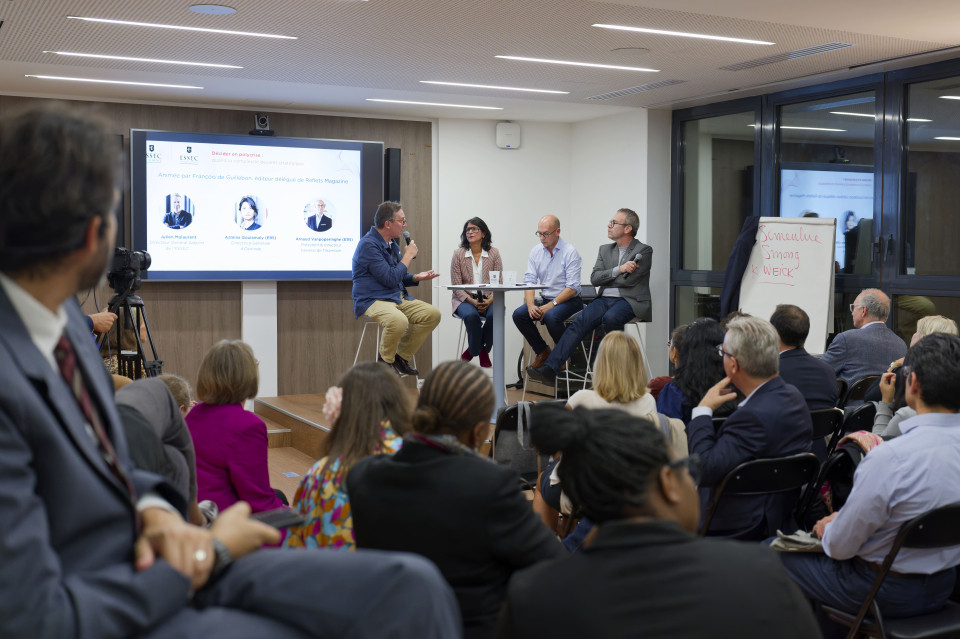
Finally, many questions from the audience focused on artificial intelligence. Laurent Bibard pointed out that “AI is not a technological question. It is a question of human arbitration, of our relationship with the tool.” On the business side, Arnaud Vanpoperinghe says he is torn between his drive as a business leader and his doubts as a citizen. Julien Malaurent, for his part, warns against individual uses that create isolated islands: “Collective intelligence is more important than ever in the age of AI.”

Comments0
Please log in to see or add a comment
Suggested Articles


