

Automatically generated translation
Making beautiful clothes locally, from fine natural materials: that is the ambition of Cabane, the knitwear brand founded in 2013 by Alix Briffaud (M10). Long dedicated to menswear, the brand launched its first women’s collection in September. In a clothing market under strain, the founder is betting on proof rather than labels. We met her.
“I had roughly 100% motivation, but on everything else, I didn’t really tick the boxes.” When she looks back on Cabane’s early days, what Alix Briffaud remembers most is her desire to create something different. “I dropped everything to set up my brand. It was love at first sight.” An agricultural engineer and graduate of ESSEC’s Mastère in International Purchasing Management, she began her career at the Nestlé group as a buyer. But the real turning point came with her second job, when she flew out to New Zealand and Australia for Groupe Barbier, an industrial plastics specialist. There she discovered the expertise of a merino sheep farm. Back in France, she developed a passion for the textile trades of the Roanne area.
A brand without a logo
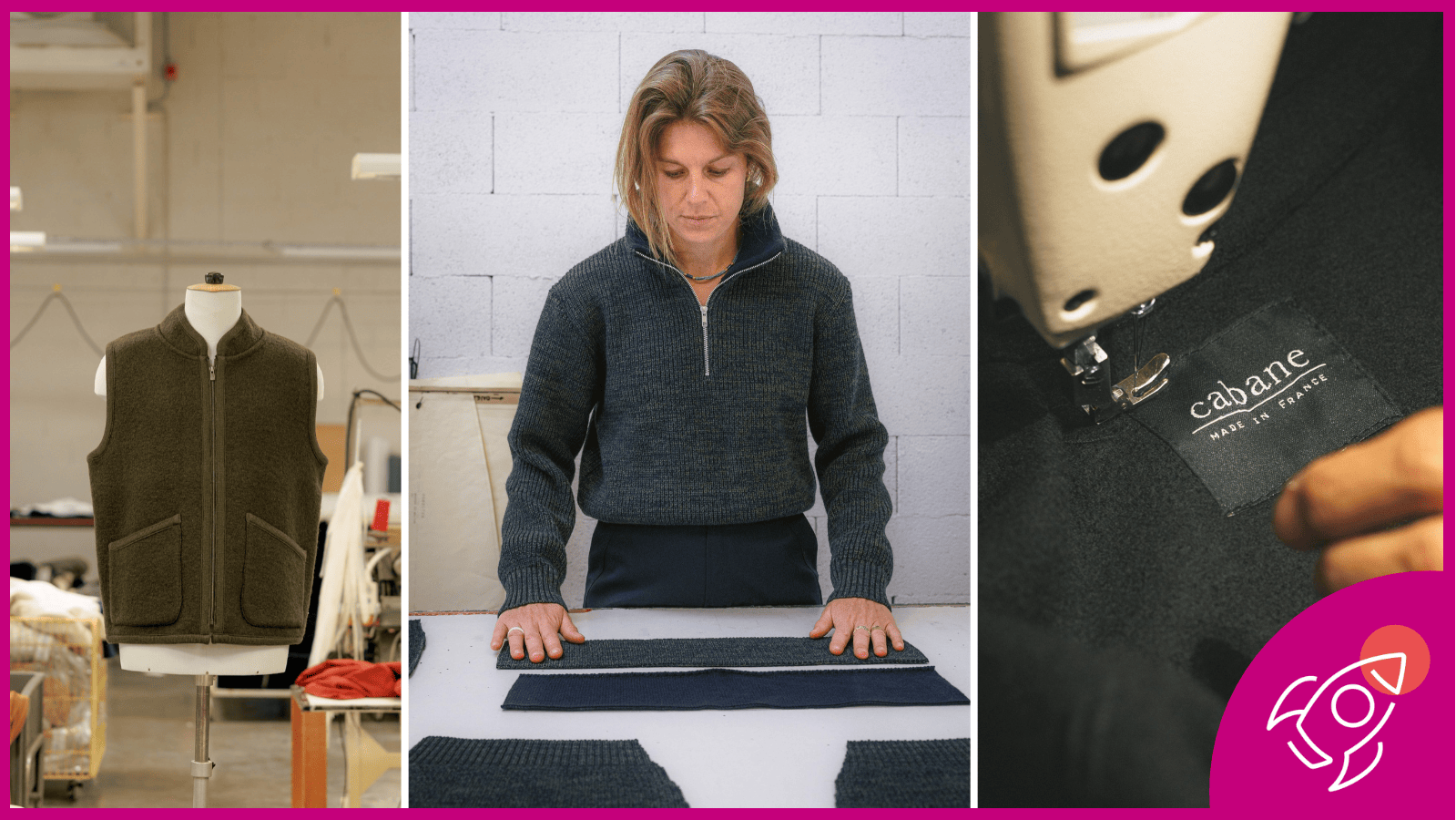
She launched Cabane at a pivotal moment for the French textile industry. The Made in France trade fair was created in 2012, and with each edition the offering has exploded. “At the very beginning, there must have been 200 to 300 exhibitors for 40,000 visitors. Today the fair brings together more than 1,000 exhibitors and nearly 120,000 visitors every year.” With Cabane, she envisaged a brand without a logo, much to the surprise of those close to her. “It’s the bias of a whole generation: for a garment to be expensive, it needs a label,” she says wryly. Her collections are made up of clean, timeless pieces: jackets, jumpers and polo shirts, logo-free and very well made. She works exclusively with local workshops: Jersey de la Buche for knitting, Devernois for washing the panels, the Jean Ruiz manufacture for pressing and Textile Mary Maille for making up. The label simply bears the brand name and the words “Fabriqué en France” (Made in France).
While enthusiasm for Made in France is real, actually buying is another matter. Ready-to-wear made in France currently accounts for less than 4% of French people’s clothing purchases. Most French textile production is luxury and goes abroad, to Asia and the United States. “There’s a big gap between knowing you should do it and actually doing it,” she observes.
A detour into services
Three years after the launch, the numbers didn’t add up: the brand wasn’t generating enough margin to pay her a salary. “My weak point was really sales and marketing,” she admits. The solution came from her hands-on skills. From 2016, small brands born on Instagram approached her to create their knitwear lines. The factories had no one to support these designers starting from scratch. So she became an intermediary: sourcing materials, prototyping, getting into production, right through to delivery. Requests poured in, to the point where she was turning clients away. Meanwhile, Cabane ticked over, keeping its menswear line.
After Covid, volumes collapsed and several client brands closed. “Services are fine, but they take up an enormous amount of time. The more you give, the more you grow, and you can never stop.” She then chose to put all her energy into Cabane, aware that profitability would take time. “Stopping a brand and picking it up again five or six years later is a bit like starting from scratch.”
Since spring 2025, she has devoted herself entirely to Cabane. Her first women’s collection came out in September, on pre-order. Zip-up or buttoned cardigans, an oversized jumper, a half-zip, boiled-wool jackets with or without sleeves: each design is adapted from a men’s piece, in the same material. “It isn’t a unisex collection. It’s the men’s collection that drives the women’s.” Pre-orders, opened when knitting begins, fix the number of pieces but allow her to adjust the size breakdown according to orders.
A market under strain
The backdrop remains difficult: squeezed purchasing power, rising costs, ultra-fast fashion and dumping, deserted town centres... “For a customer today, it’s very hard to know what they’re

Comments0
Please log in to see or add a comment
Suggested Articles


