From School to Network: ESSEC x ESSEC Alumni foster entrepreneurship

At ESSEC, entrepreneurship is not a narrow path reserved for a select few: it permeates the programmes, is supported by incubation and acceleration initiatives, and continues beyond graduation through a structured alumni community, from Station F to the Entrepreneurs Club.
Uniting, inspiring, supporting: The Strenght of the ESSEC Alumni Entrepreneurs Club
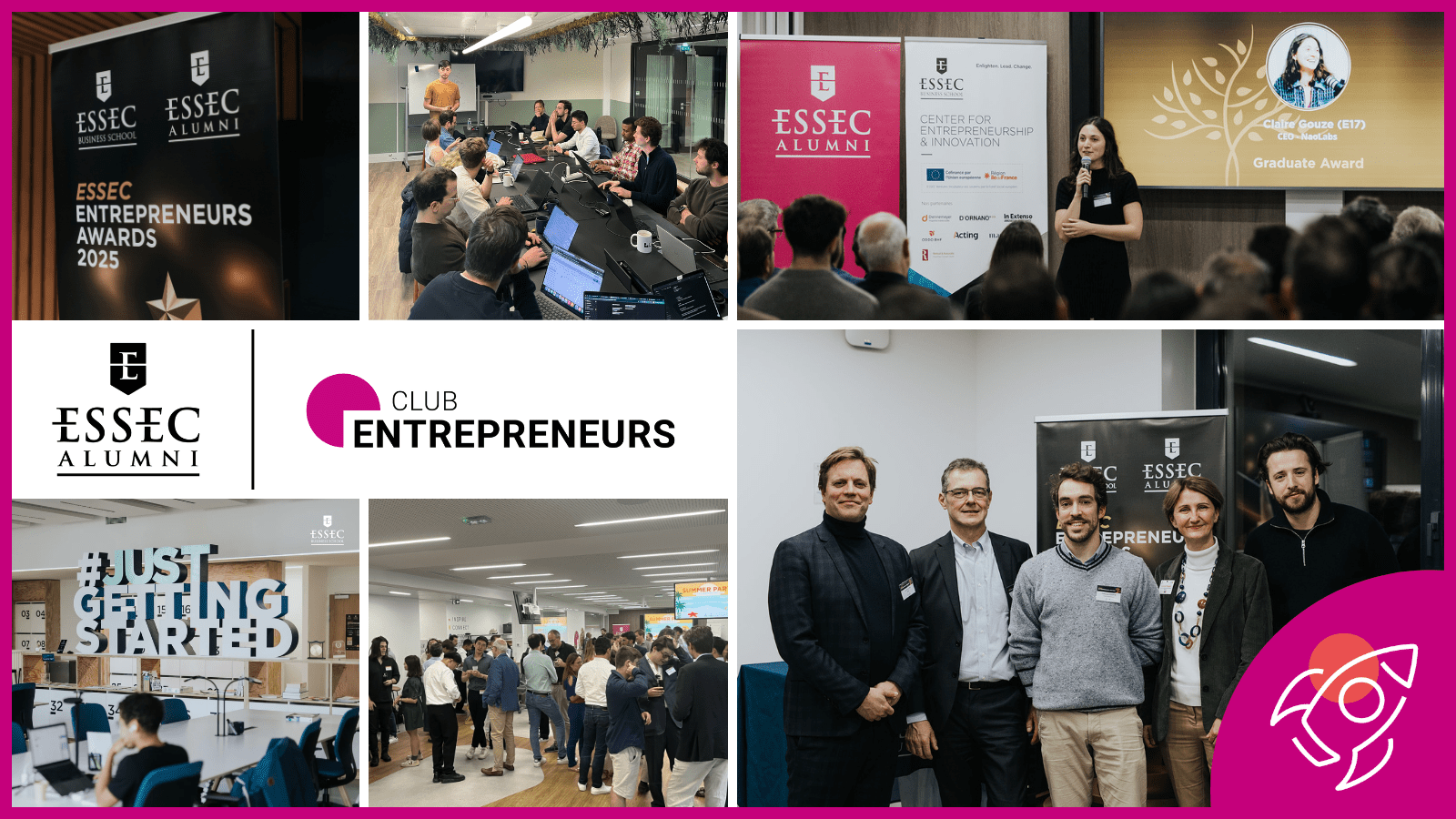
Since its creation, the ESSEC Alumni Entrepreneurs Club has become a cornerstone of ESSEC’s entrepreneurship ecosystem, bringing together several thousand alumni around mutual sup- port and exchange. Founded in 2017 by Pierre-Emmanuel Saint-Esprit (E16), and boosted after Covid, it now counts 3,200 members, including 2,200 active on a Slack community built on a “pay it forward” spirit. “Our ambition is clear: to create a global pathway for ESSEC entrepreneurs, from their very first day at the school to every stage of their professional lives,” says François Courtin (E10), former entrepreneur and President of the ESSEC Alumni Entrepreneurs Club. The Club combines online connections with regular events—interviews, round tables, masterclasses and quarterly Zoom Cafés— plus two annual highlights, the Summer and Winter parties. A flagship mentorship program matches around 30 pairs each year, supported by more than 150 volunteer mentors and a dedicated follow-up. Working alongside the Business Angels Club, sector clubs and the Station F incubator, it aims to create a global pathway for ESSEC entrepreneurs, from school to every stage of their careers. “Our role is to support a community of humanist, future-fit leaders, and to provide ESSEC alumni with an entrepreneurial support pathway. And this in close partnership with the school,” emphasizes Isabelle Frappat, Director of Communities France at ESSEC Alumni.
Corentin Grenon (E20): The Entrepreneurial Spirit of ESSEC in Action
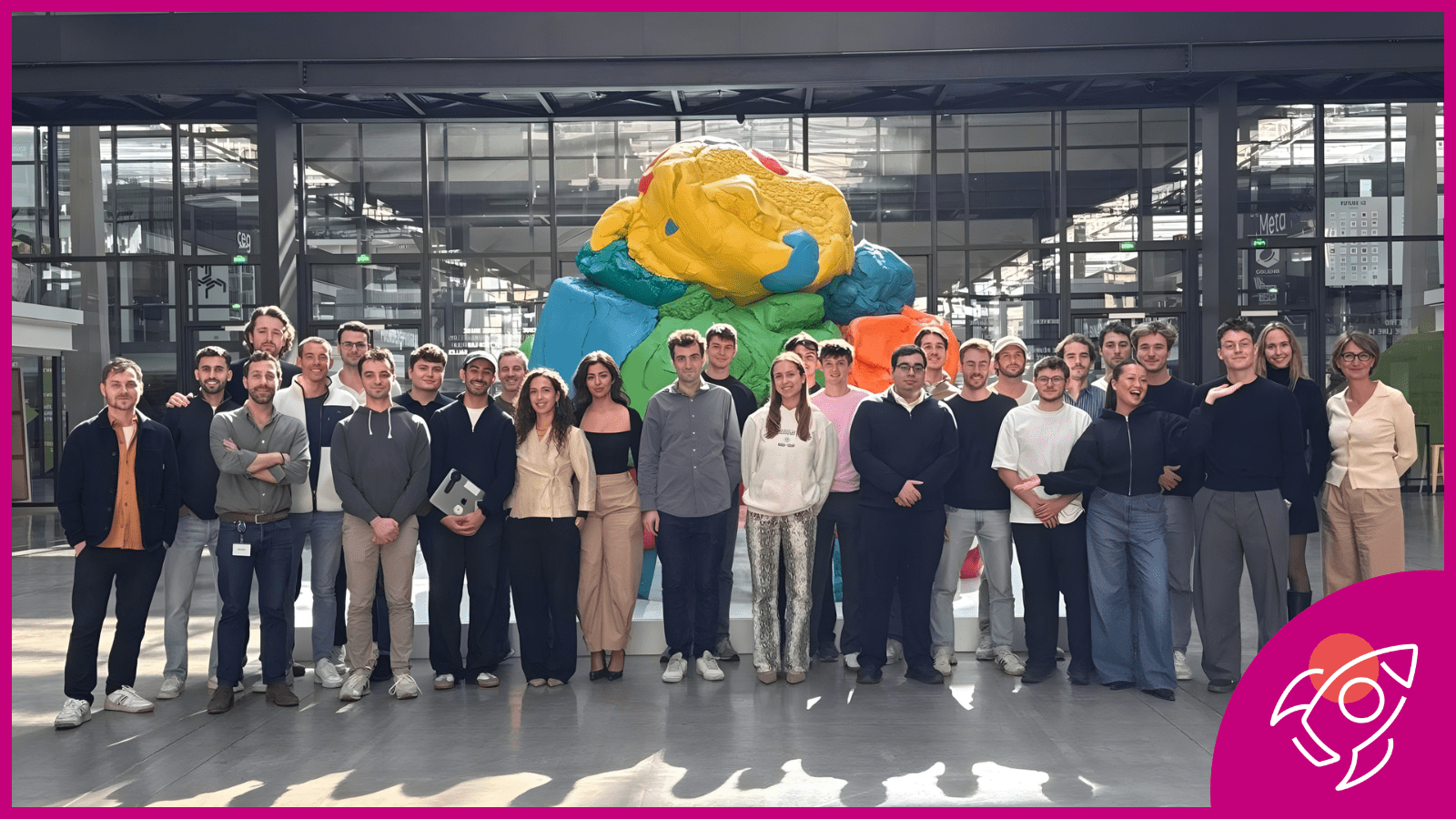
At 26, Global BBA graduate Corentin Grenon (BBA 20) leads ESSEC’s incubator at Station F. founded by ESSEC and ESSEC Alumni. From his first year, he chose “the riskiest but most exciting option”: founding companies. With classmates, he launched Leqto, then Formalý, before selling a SaaS tool for digitalizing training providers in 2022. Raised between India and the United States, and with two entrepreneurial grandfathers, he started early—selling cashmere scarves at 13. In 2023, ESSEC and ESSEC Alumni asked him to head the incubator. He now supports around thirty alumni projects a year, looking for “the spark” and a team obsessed with a real problem. 86% of supported startups remain active; 43% have raised seed funding; two have been acquired. He runs the program with empathy and rigor, as a safe space to test, fail, and regain perspective. His benchmark is not just profit, but lasting value.
+40 startups incubated in one year at Station F
200 hours of coaching provided by more than 100 experts and mentors
40 events and workshops organized per year
A global ecosystem: Entrepreneurship at ESSEC in Singapore
Since 2022, ESSEC has been building a distinctive entrepreneurship ecosystem in Singapore, anchored in its Asia-Pacific campus and driven by the ESSEC APAC Center. Here, entrepreneurship is not a standalone track: it runs through all programs, from the BBA to the Executive MBA, with a “learning by doing” approach. Students work in project-based formats, often mentored by professors who have founded or led ventures. “We are not aiming to turn every student into an entrepreneur, but rather to instill fundamental entrepreneurial skills essential to any future leader: agility, initiative, and the ability to navigate uncertainty,” says Julien Salanave, Director of the Entrepreneurship program in Singapore. Inspired by the French model, ESSEC Ventures APAC was launched in 2022 and incubates around ten projects a year. Initiatives such as Startup Weekend Impact (2021) and the Create4Good Hackathon (with SUTD, 120–160 participants annually) connect ESSEC to Singapore’s wider innovation scene while reinforcing its own identity: turning ideas into projects, and projects into solutions for tomorrow.
Deep Tech: How ESSEC Entrepreneurship is Shaping the Industries of Tomorrow
At ESSEC, Deep Tech innovation is positioned as a strategic lever for societal and economic impact, aligned with national priorities backed by Bpifrance and the France 2030 future investment plan. “Unlike traditional ‘Tech,’ which is primarily digital, Deep Tech draws on highly specialized scientific knowledge,” says Sarah Nokry, Director of ESSEC Momentum Studio. Through ESSEC Momentum Studio (supported by CNRS, CY Cergy Paris Université and funded by PIA4), around ten projects a year are guided from ideation to team building and market strategy. One emblematic case involved a fluid simulation tool from a public lab: after a technology audit, the team identified more than 100 use cases, assessed feasibility and market potential, and found a viable business model in six months. Co-designed with CentraleSupélec and the Systematic Paris-Region cluster, Deeptech+ offers the certified “Launch” and “Pulse” tracks. Its goal is to train 850 talents over five years, leading to 300 startups and 3,500 highly skilled Deep Tech jobs.
Entrepreneurship at ESSEC: A Strategic Commitment to Shaping Tomorrow’s World
Amid major economic, environmental, technological and social shifts, ESSEC Business School has put entrepreneurship and innovation at the core of its strategy. Dean and President Vincenzo Vinzi argues that only entrepreneurial leaders can navigate uncertainty, explore markets in new ways, harness emerging technologies and shape new business models. Led by the Institute for Entrepreneurship & Innovation, ESSEC’s ecosystem rests on four missions: inspire, train, incubate & accelerate, and connect—building links with partners, investors and support networks. The School pursues three routes: launch ing a venture from scratch, pursuing disruptive innovation rooted in research, or preparing for business acquisition. It aims to nurture entrepreneurial thinking in over 12,500 students through action-based learning open to all profiles.
200 projects supported founders annually supported by ESSEC Ventures each year
+600 founders supported each year
15 Deep Tech ventures created each year by dual-degree scientific profiles
Entrepreneurship at ESSEC: Lead’Hers is Redefining Women’s Leadership
At ESSEC Business School, entrepreneurship is closely linked to inclusion, commitment and impact. Created with CentraleSupélec, Lead’Hers supports women entrepreneurs whose paths often reflect career or personal turning points, yet share the same ambition: building projects that matter and open doors for others. The five-month programme for students and alumnae combines individual and group support and currently brings together 15 women entrepreneurs. It starts with a collective-intelligence day to clarify needs and build cohesion, then continues with learning expeditions, workshops, masterclasses and conferences. Long-standing partner VO2 Group contributes to the empowerment dimension, helping participants tackle gender stereotypes, funding barriers and self- lim iting biases. Mentoring and personalised follow-up extend beyond the programme itself. “Some arrive with early-stage projects, others with established ventures. Lead’Hers helps them move forward at their own pace, in a supportive community that lifts everyone higher,” concludes Morgane Effroy, Lead’Hers Program Coordinator.
Living entrepreneurship every day: A Collective Journey Accross All Campuses
At ESSEC, entrepreneurship is woven into student life, beyond classrooms and incubators. Clara Marte (E27), second-year Master in Management student and President of ESSEC Initiatives (2024-2025), sums up the association’s role: not to incubate projects like ESSEC Ventures or Antropia, but to “inform, inspire, and spark new ambitions”. The team organises conferences, forums, round tables and pitch sessions, and runs consulting projects for companies. With open events reaching ESSEC, local peers and even high school students, the association aims to make entrepreneurship accessible. Students learn by doing—persuading, collaborating, supporting one another—and build rigor, empathy, boldness and resilience. More than 80 entrepreneurship-focused events are hosted for students each year. Some take place within ESSEC campuses: “Speaker Series” brings entrepreneurs and investors to share their journeys, while “Pop-Up Startups” transform campus spaces into showcases for student-led ventures. Others extend beyond the school walls. The ESSEC ecosystem also provides concrete resources: collabora- tive hubs such as the K-Lab, a unique space for the 600 students who launch a venture each year; research chairs dedicated to innovation; and, above all, a multicultur al and interdisciplinary environment that fuels collabo- ration and creativity.
A global ecosystem: Entrepreneurship at ESSEC in Morocco
From its Rabat campus and alumni network, ESSEC Business School is building a purpose-driven entrepreneurial ecosystem in Morocco, with Africa at its core. Since 2018, In-Lab Africa, in Rabat, has supported pan-African project leaders through co-creation with businesses, researchers and local authorities. The #63 Changemakers program (with Tibu Africa) helps young people launch high-impact sports initiatives. With Mohammed V University, ESSEC has guided more than 250 women and funded over 16 companies through awards. Co-organised with Dislog Group, the Dislog Entrepreneurs Awards aim to structure high-potential startups (includ ing Green Tech), with winners joining a learning expedition in France at ESSEC and Station F and taking part in Global Entrepreneurship Week on November 11. Within this dynamic, ESSEC has launched its first geographically focused Chair on the Rabat campus: Business and Industry in Africa, supported by Africa Global Logistics, ARISE IIP, and the IBL Group. Leveraging its alum ni network and industrial and academic partners, ESSEC is establishing in Morocco an unprecedented model: a pan-African entrepre- neurial innovation hub, connected to the school’s other ecosystems in Europe, the Atlantic Africa region, and Asia-Pacific.
63 projects supported by the Africa Sports Changemakers program
80 women rewarded by the Lalla Meryem Prize
+150 entrepreneurs sensitized per year
Programs and corporate support: When Entrepreneurship Becomes a Driver of Transformation
As companies look for sustainable ways to innovate and adapt, ESSEC positions entrepreneurship as a transversal skill: a mindset that helps professionals act under uncertainty, take initiative, and transform their environment. “The entrepreneurial mindset is not reserved for startup founders,” says Jan Lepoutre, Professor at ESSEC and Academic Director of the ESSEC Institute for Entrepreneurship & Innovation. ESSEC Executive Education emphasizes experience-based learning, aiming to build an “entrepreneurial posture,” explains Sammy Bahda Delattre. Flagship initiatives include 10,000 Small Businesses France (launched in 2020 with the Goldman Sachs Foundation), “designed for established businesses looking to scale,” the Michel angelo (Homo Faber) Fellowship, and Aristée for agricultural coop er atives, developed with Coop de France and DIRCA. Through such initiatives, ESSEC demonstrates its ability to design tailored programs, adapted to each sector, culture, and organization. It confirms that entrepreneurship, far beyond new venture creation, has become a powerful lever of sustainable transformation for established companies.
Rethinking entrepreneurship: When Research Drives Action
At ESSEC, research is not an ivory-tower exercise: it is lived, shared and tested to inform action and prepare organizations for tomorrow’s challenges. Charles Ayoubi (E13), Assistant Professor at ESSEC Business School, studies how ideas emerge, are assessed, selected or abandoned inside companies, at a time when generative AI is reshaping collective creativity. Working closely with a dozen organizations, from SMEs to global players like Procter & Gamble, he combines field experiments and observational studies to understand what works and share insights with students and decision-makers. His current work explores how firms adopt generative AI, highlighting that success depends on managerial and social skills as much as technical ones, and raising inclusion questions, notably gender gaps. In class, he bridges research and practice through data, cases and simulations—such as creating a company in 90 minutes—while stressing that AI may help filter ideas, but final judgment must remain human. That is ESSEC’s ambition: to train enlightened innova- tors, capable of transforming ideas into actions and actions into impact.
This article is part of the ‘‘1,001 ways to be an entrepreneur’’ topic in our latest Reflets Mag dedicated to entrepreneurship:

Comments0
Please log in to see or add a comment
Suggested Articles