
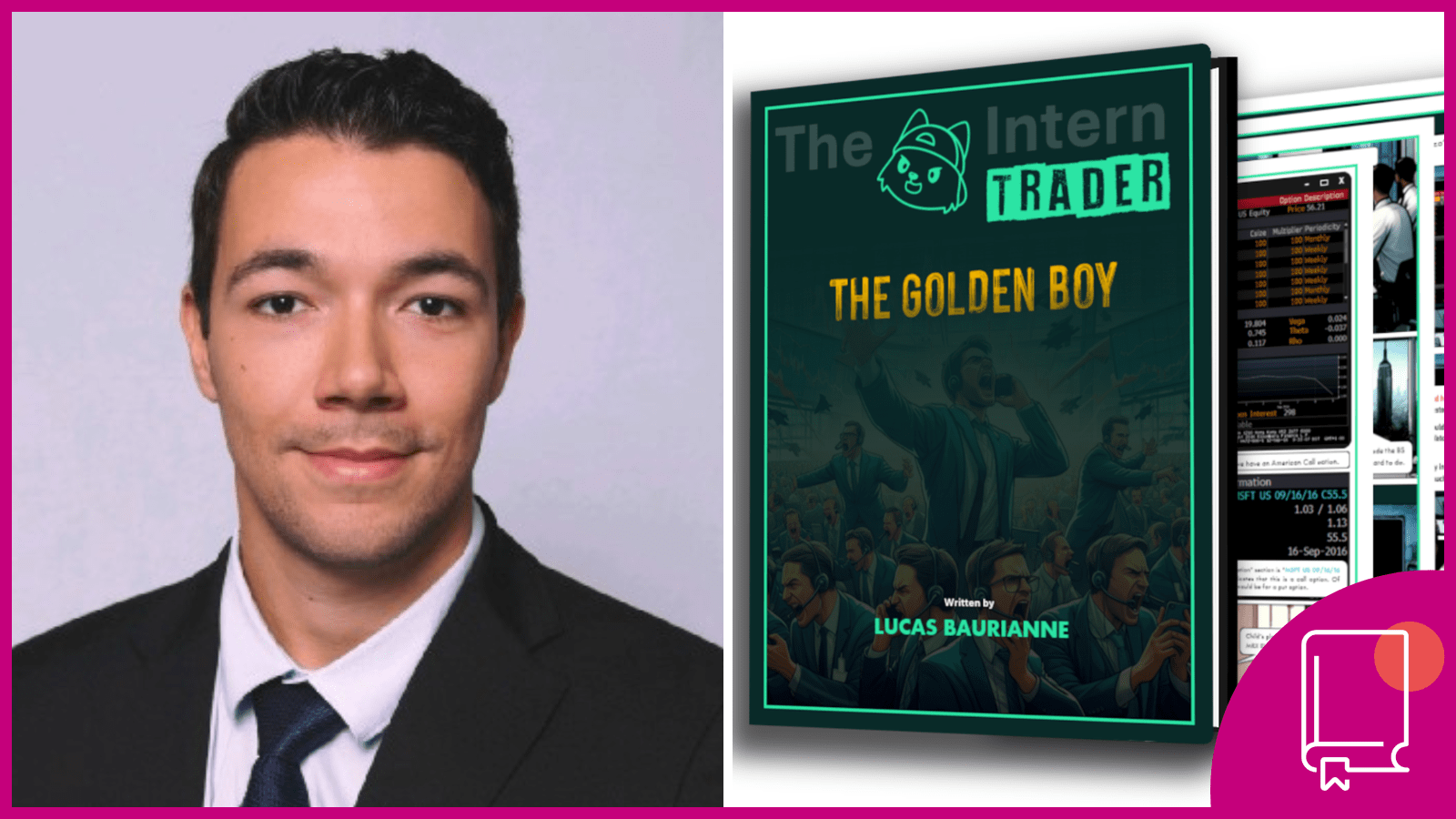
Currently a student on the Grande École programme, Lucas Baurianne (E27) is publishing his second graphic novel: The Golden Boy. Educational and immersive, it lets readers step into the life of a trader through the character of Enzo. Let’s meet him.
ESSEC Alumni: Could you introduce your graphic novel?
Lucas Baurianne: The Golden Boy – Global Markets is an educational graphic novel that combines an immersive story set in one of the capital’s most prestigious trading floors with a genuine introduction to market finance roles and financial products. The project is built on a simple idea: to enable readers to understand what it means to work on a trading floor before they ever set foot on one, by first giving them the technical keys and then showing them immediately brought to life in the fiction.
The operational sections were developed alongside experienced professionals in Sales, Structuring and Trading, then thoroughly reviewed by Nicolas Walon, Head of Global Markets at Lombard Odier—one of the most prestigious institutions in the world—as well as by experts from leading investment banks.
The graphic novel is prefaced by two academic figures and former professionals of international renown: Jaehyuk Choi (Columbia University) and Olivier Bossard (HEC Paris). Their perspective gives the project a rigorous and credible foundation, true to the ambition of making financial markets both understandable, appealing and accessible.
EA: What led you to launch this project? What observations and challenges did you start from?
LB: The idea came from a very simple observation: it was almost impossible for me to explain clearly to my friends what people actually do in market finance. For many, this world seems abstract, complex—almost inaccessible, whereas it is in fact fascinating once you understand how it works. At the same time, I had dozens of calls with students looking to break into market finance, and I realised there was no resource that was simultaneously educational, practical and enjoyable to read. So I wanted to create a book that’s easy to read and can help as many people as possible, to share what I would have liked to have at the start of my journey, and perhaps (I hope) spark vocations for these wonderful careers.
Another point particularly struck me: in business school, many students self-censor and close the door on market finance, thinking the sector is reserved for profiles from top engineering schools. That’s false. There are very solid pathways for business-school students, provided they have the right explanations and the right reference points. So I wanted to reduce this kind of “academic FOMO*” by offering a graphic novel that demystifies the field, explains its codes simply, and shows—through a story— that the technical side can be made clear, practical and accessible.
* “Fear of Missing Out”
EA: Why did a graphic novel feel like the right answer to those observations and challenges?
LB: Because it addresses exactly the problem I was seeing. In market finance, most existing resources are very academic books, extremely comprehensive (they’re essentially dictionaries of market finance), but also so dense that you can quickly get lost and often difficult to read after a day of classes or an internship. You find the theory, but you sometimes lose the energy, the pace and the human dimension of the job. The graphic-novel format, by contrast, is far more engaging: you open the book and you’re immediately plunged into the action, the dialogue, the Bloomberg screens, the tension of a live trade. In short, you can already picture yourself on the trading floor—or at least project yourself into it.A graphic novel also enables something unique: you put yourself in the shoes of the character, Enzo. You experience what he experiences, you feel the pressure, the stress, the adrenaline, and you can actually visualise situations you never see in a course. It changes everything when it comes to understanding market finance, because you’re no longer stuck in abstraction: you see the business, the interactions, the constraints, the timeline of a trade, and how theory really translates on screen.
Lastly, I’m convinced that practice is just as important—perhaps even more so—than theory when it comes to understanding these roles. The graphic novel makes it possible to show both in one flow: you explain a concept, then the very next scene immediately applies it on a desk. That direct link between theory and practice, told in a dynamic format, makes learning clearer, more intuitive and far more motivating.
EA: In practical terms, how did you go about it—first from a drawing perspective?
LB: Most of the illustrations were generated one by one using AI, but nothing was left to chance. Each image is then retouched, corrected and enriched with details to ensure the coherence of the universe and visual continuity between scenes. As AI is never perfectly accurate, you often have to rework the generation prompt dozens of times before getting an image that truly fits with the previous page. Across 250 pages, with an average of six images per page, it amounts to a colossal effort.
Alongside that, I added my own explanatory diagrams. I first drew them by hand, then redrew them neatly in PowerPoint and/or Photoshop to achieve a clear, educational result. I also recreated all the messaging apps used in the story, as well as the conversations, which was done entirely without AI. And to make everything ring true, I drew on hours of calls, trading-floor observations and personal experience to capture as accurately as possible the situations, dialogue, screens and workflows featured in the book.
Ultimately, I wanted to show that with creativity and a lot of hard work, AI can become a powerful tool to produce something beautiful, coherent and immersive—not as a replacement for human work, but as a real accelerator for creation.
EA: And then from a writing perspective?
LB: For the text, I worked in two main phases. The first chapter, which lays out all the technical fundamentals, was produced in direct partnership with Maxime de Bellefroid, a recognised trainer on the most complex products on a trading floor. We worked together to make the concepts precise, educational and accessible, while maintaining the rigour that market finance requires.
For the rest of the book, I took an approach much more rooted in real-world practice. The chapters dedicated to the different roles were built in collaboration with Sales, Structuring and Trading professionals, and fuelled by hours of calls, discussions and anecdotes I collected over time. I included what I observed myself on the desk, the advice I received, typical situations, authentic dialogue and professional reflexes that only practitioners can truly pass on. The aim was for every page to feel true, for readers to recognise the voice of real pros behind the scenes—without clichés—and to learn market finance through its concrete reality.
EA: In particular, how did you develop your expertise on the subject on the one hand, and your teaching approach on the other, given that you are still a student yourself?
LB: I developed my expertise thanks to a highly formative internship in structuring on BNP Paribas’s trading floor. It’s one of the most formative internships because you see the entire chain behind a structured product and work hand in hand with salespeople and traders. That immersion gave me a very practical understanding of how a desk operates.
I was also lucky to be surrounded by a team that took the time to explain things, help me improve and pass on their professional reflexes.
Alongside that, I’m genuinely passionate. Since my first graphic novel, I’ve spoken a great deal with professionals, which has fed me with anecdotes, advice, typical mistakes and ways of thinking about the market.As for the teaching approach, it came quite naturally. I’ve always tried to understand how to make something complex clear and intuitive—how to explain it to a friend without jargon, how to visualise an abstract concept. The graphic novel gave me the ideal format to turn that approach into a concrete tool that speaks both to the reader’s logic and imagination.
EA: Which ESSEC people took part directly in producing the project?
LB: I was lucky to be helped by several members of the ESSEC community who contributed directly to the graphic novel and without whom the project would not have had the same depth.
My friend Maria Abi Aad (M24), now EMEA Rates Sales at Wells Fargo, helped me a great deal with the whole Sales side. She shared her feel for the job, her anecdotes, what makes a good salesperson in her view, and above all how to explain it in a simple, schematic way. As she started her permanent role fairly recently, she brings a fresh, very current perspective that perfectly complements that of more senior professionals. This mix of perspectives—early and late career—allowed me to compare viewpoints and make the graphic novel as faithful as possible to reality. I’m truly grateful for her availability and transparency.
On the School side, I received exceptional support: Paul Massart, Director of Student and Residential Life, supported me from start to finish with regular meetings to track the progress of the graphic novel. He put me in touch with everyone likely to help, gave me excellent ideas and supported me with funding.
Chloé Guilbert (E09), at ESSEC Alumni, also devoted a great deal of time to point me towards the right contacts, give me very useful advice and believe in my project from the outset.
I would also like to thank Vincenzo Vinzi and Étienne Fulchiron for believing in my project and supporting it with a wonderful message at the beginning of the book.
Lastly, ESSEC Transaction, with Edgar Pennera (E27) and Anas Chahbouni (E27), followed and supported the project, particularly in terms of promotion and communications.
I’m deeply grateful to each of them. Their help, advice and trust mattered far more than they realised in the success of this graphic novel.EA: What about the directors of the Master of Financial Mathematics at Columbia University and the HEC Paris Master in Finance?LB: I was fortunate to be supported very early on by Olivier Bossard, former Director of the HEC Paris Master in Finance and a highly respected professional. After discovering my first graphic novel, he immediately connected with the concept and offered to help with the release of this second volume. He played a decisive role: he reviewed the graphic novel as a whole, encouraged me to refine certain passages, clarify others, and strengthen the overall pedagogical coherence. His perspective—both academic and pragmatic—helped me take the project to the next level.
As for Jaehyuk Choi, Director of the Master of Financial Mathematics at Columbia University, his involvement is different but just as valuable. He agreed to write the foreword and associate his name with the book, which is a tremendous honour. He is one of the biggest names in quantitative finance, recognised worldwide. The fact that he supports the project gives it international visibility and rare academic credibility for an educational graphic novel. His foreword adds further legitimacy to the approach by showing that finance can be learned in a modern, visual and engaging way.
EA: Ultimately, which audiences are you targeting with this graphic novel?
LB: First and foremost, the curious. The graphic novel is aimed as much at students discovering market finance as at those who already know the sector and want to deepen their knowledge—whether of the technical side, the business side, or the interactions between roles. It can also help a student or intern understand the role of other desks—for example, a salesperson who wants to visualise concretely what a trader and/or structurer does.
It also targets young professionals, and quite surprisingly, it also attracts mid- to late-career professionals, curious to see how their work is portrayed in a narrative and educational format.
Lastly, it also speaks to a wider audience, simply interested in the world of trading and keen to understand what really happens behind the screens and the clichés. The goal is genuinely to reach everyone who wants to discover this universe, whatever their starting level.
EA: Is your graphic novel “only” an educational tool? Or does it also reflect your own distinctive view of market finance?
LB: It is above all an educational tool. The main objective was to make market finance understandable, practical and accessible, by explaining the roles and mechanisms as they really are, without over-interpretation or caricature.
Beyond that, I didn’t try to offer a personal opinion or an “author’s” viewpoint on the industry. I’m still young and naturally lack the hindsight to make a broad judgement on market finance. I don’t think that would be legitimate. What I do know, however, is what I’ve seen, lived, heard and studied. So I wanted to portray things as faithfully as possible, drawing on my own personal experience as well as the experience of the professionals who supported me.
EA: In your view, what are the key trends in the sector today?
LB: Today, market finance is moving at an incredible pace and several trends stand out clearly. First, automation is taking a huge place. Products are increasingly priced or executed automatically, which completely changes the role of teams, who find themselves more focused on supervision and managing more complex situations. Coding and data are playing a growing role: it doesn’t replace market intuition, but it helps you move faster, be more efficient and make better day-to-day decisions while avoiding errors as much as possible. Finally, there’s been a real return of macro, driven by inflation, central bank decisions and the geopolitical context, which significantly influences how desks operate. Profiles capable of thinking cross-asset are also gaining a lot of value, because issues are becoming increasingly transversal and no longer stop at a single silo.
EA: Its strengths and weaknesses economically, in the current climate?
LB: The first strength, in my view, is its ability to adapt very quickly. Desks react almost in real time to central bank decisions, macro surprises/tensions, and that agility remains a huge strength. Volumes are there, volatility too, which creates opportunities for trading, structuring and sales teams. The diversity of products is also a strength, because it enables banks to respond to very different needs—whether hedging, yield or risk management.On the weakness side, the environment isn’t easy either. Regulatory pressure remains heavy and imposes strong constraints in terms of capital allocation, which sometimes limits desks’ ability to take risk or develop certain products. Automation, even though it is a strength, can also create a gap between highly technical profiles and those who struggle to keep up with the evolution. Hence the importance of training future finance professionals in data tools. Lastly, macro uncertainty remains high—inflation, tighter monetary policies, geopolitics… all of this can slow activity in certain segments and create a less predictable environment.
EA: Its qualities and shortcomings from a societal perspective, in the face of today’s major social and environmental challenges in particular?
LB: In my view, it isn’t as abstract as people think, and it certainly isn’t just “to create shareholder value”. In reality, market finance has a real societal role: it finances the economy, supports innovation, enables companies to hedge against all sorts of risks, and increasingly supports the energy transition through new products and new standards. People often talk about numbers, but behind those numbers there are projects, jobs, and sometimes even major environmental and technological advances.
Of course, not everything is perfect, but I feel the sector is making genuine efforts to evolve, modernise and better integrate social and environmental issues. And you can see it: mindsets are changing, expectations too, and finance both follows and encourages that movement. It is a sector in transformation and, I believe, it has a positive and practical role to play in today’s major challenges.
EA: And what clichés about the sector (positive or negative) are you keen to challenge?
LB: For me, two clichés come up regularly. The first is the idea that market finance is a “man’s job”. Today, that’s no longer true. Mindsets have evolved a lot, there are more and more women on the floors, and it’s clearly easier to establish yourself than it was a few years ago. We’re still a long way from a 50–50 balance, but the trend is moving in the right direction—and it’s worth saying, because it can genuinely encourage female students to go for it.
The second cliché is that the sector is reserved for engineers or ultra-technical profiles. That too is false. With good teaching, curiosity and a real interest in the subject, any motivated student can understand the mechanisms and thrive in this world. Of course, it won’t be easy, but it’s a great challenge. The graphic novel is precisely there to show it: it’s not “too complex”—you just need to visualise things and see how they apply in practice on a desk.
EA: And you—what are your ambitions in the sector?
LB: I still have a long way to go. The advantage of the trading floor is that you never stop learning. So after experiencing structuring, I’d like to try trading and sales to see what suits me best personally. I’m very curious, so I want to test and feel what each role involves day to day before choosing my path. For now, I can picture myself in trading quite well, but I’m keeping an open mind. Time will tell where I’m most useful and where I thrive the most.
EA: In particular, do you plan to write other works about the sector?
LB: I’m not closed to the idea of writing another one—perhaps about the world of hedge funds, which is fascinating and still very little popularised. But one thing at a time. For now, I’m fully focused on the release of THE GOLDEN BOY – GLOBAL MARKETS. Once this volume is properly launched, we’ll see where inspiration takes me.
The Golden Boy by Lucas Baurianne (E27)

Comments0
Please log in to see or add a comment
Suggested Articles